Why K2 Trek from India is on every trekker's list
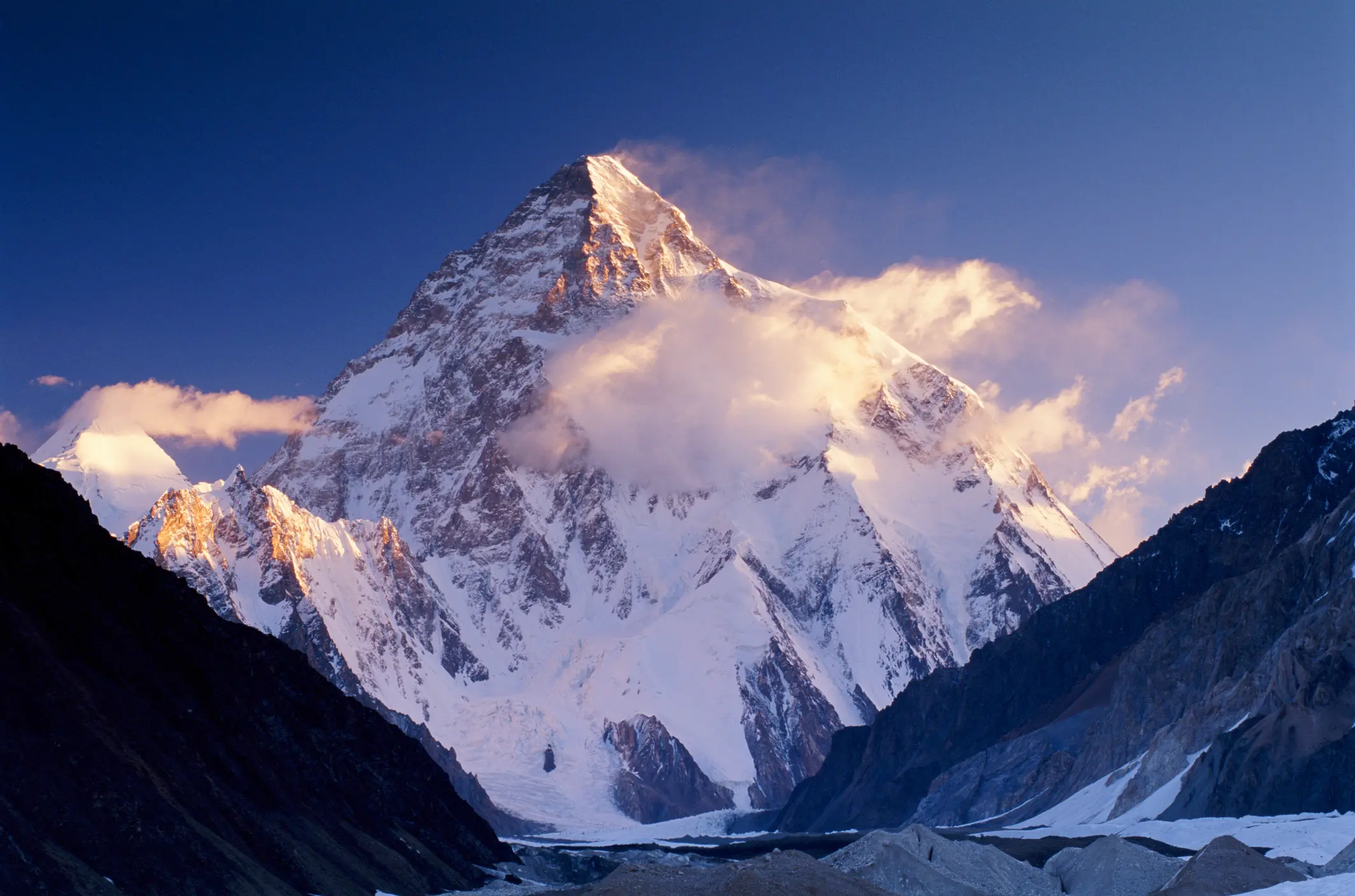
At 8,611 metres, K2 is the world's second-highest peak — and by most accounts, the most demanding. Unlike Everest, K2 has never been climbed in winter and kills a higher proportion of those who attempt its summit. But you do not need to be a climber to experience its magnetic presence. The K2 Base Camp trek from India takes trekkers to 5,150 m on the Godwin-Austen Glacier, deep inside Pakistan's Gilgit-Baltistan region, through one of the most spectacular mountain landscapes on Earth.
For Indian trekkers specifically, this journey demands extra planning. K2 sits in the Karakoram range inside Pakistan — meaning you will need a Pakistani tourist visa, a stack of trekking permits, and a clear understanding of the Wagah Border crossing or flight options into Islamabad. None of this is insurmountable, but none of it is casual either. This guide covers every step of the 2026 K2 Base Camp trek from India.
The Indian trekking community has long explored the Himalayas — Roopkund, Stok Kangri, Everest Base Camp, and dozens of routes in between. So why cross an international border into the Karakoram?
The answer is simple: nothing else looks like this.
The Baltoro Glacier — one of the longest glaciers outside the polar regions at approximately 63 km — flows between walls of rock and ice that host four of the world's fourteen 8,000 m peaks: K2, Broad Peak, Gasherbrum I, and Gasherbrum II. The viewpoint at Concordia (4,600 m), where the Baltoro and Godwin-Austen glaciers meet, is called the Throne Room of the Mountain Gods for good reason. On a clear morning, you are surrounded by more vertical relief than anywhere else on the planet.
For Indian trekkers, there is also a cultural proximity — the Balti people of Skardu share linguistic and ethnic roots with communities in Ladakh, and the landscape of Gilgit-Baltistan echoes the high desert of the Indian Trans-Himalaya. The connection feels familiar even when the experience is extraordinary.
The numbers tell the story of exclusivity: fewer than 1,000 trekkers reach K2 Base Camp annually, compared to over 40,000 who trek to Everest Base Camp each year. The Baltoro Glacier route remains one of the least crowded great mountain journeys on Earth — which, combined with K2's savage reputation, makes it irresistible to serious Indian adventurers.
At a glance
Ask TrekSage about K2 Trek from India
Get instant answers grounded in verified trek data — beginner-friendliness, best months, permits, packing, and more.
The route at a glance
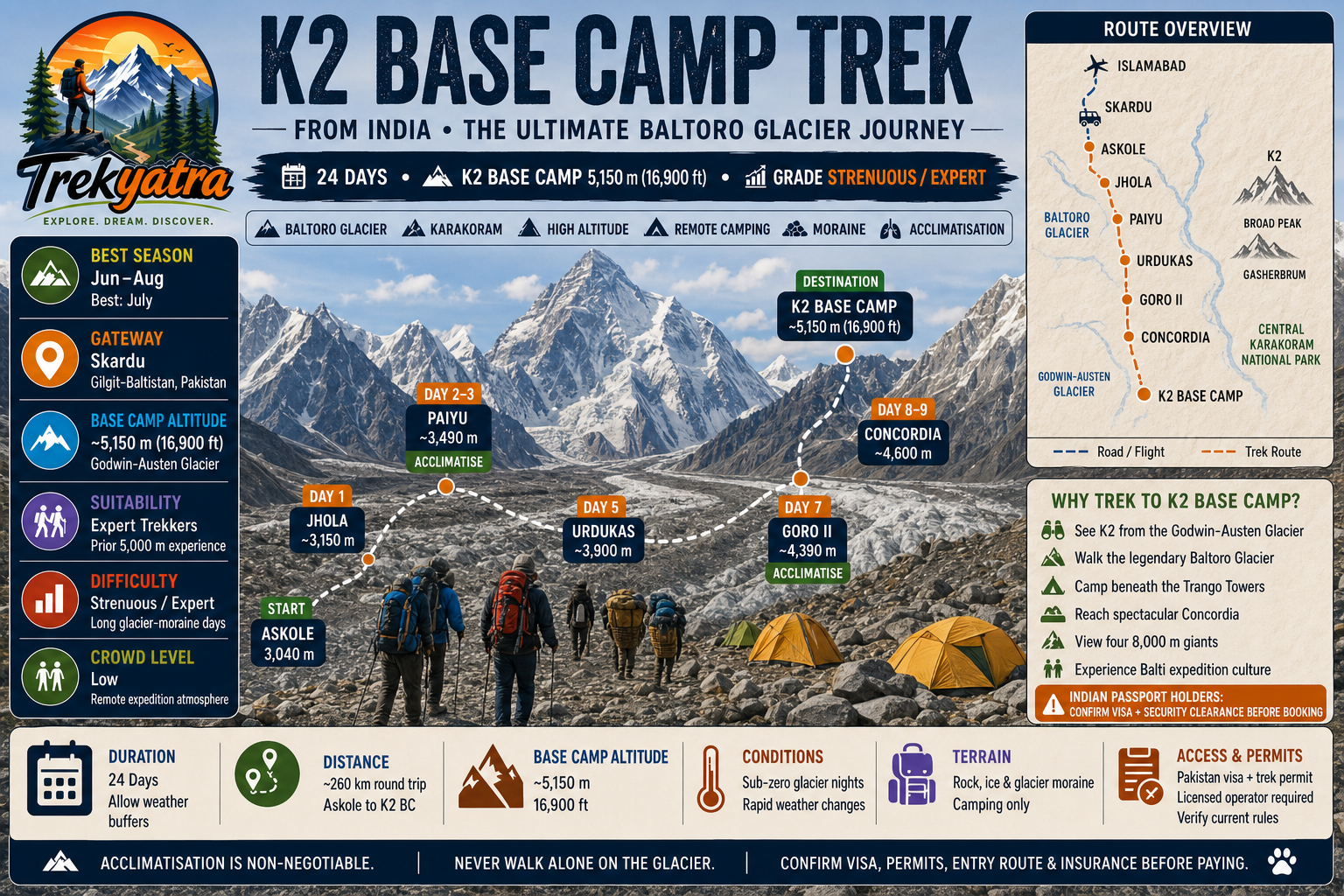
The standard K2 Base Camp trek route from India follows this corridor:
Delhi / Amritsar → Islamabad (via Wagah Border or flight) → Skardu → Askole → Baltoro Glacier → Concordia → K2 Base Camp
The trekking portion — from Askole village to K2 Base Camp and back — covers approximately 130 km one way, with the return journey retracing the same route. Askole sits at 3,040 m and K2 Base Camp at 5,150 m, meaning the total elevation gain on trail is roughly 2,110 m, spread across 8–10 days of upward trekking.
Key waypoints along the Baltoro Glacier route:
- Jhola (~3,150 m) — first campsite after Askole
- Paiyu (~3,490 m) — last green campsite, famous for the Paiyu Peak views
- Liligo (~3,380 m) — rest camp
- Urdukas (~3,900 m) — last vegetation; views open dramatically
- Gore-I / Goro-I (~4,300 m) — moraine camping on the glacier
- Gore-II / Goro-II (~4,390 m) — acclimatisation camp
- Concordia (~4,600 m) — the iconic junction and highlight of the trek
- K2 Base Camp (~5,150 m) — journey's end
The Baltoro Glacier crossing begins after Paiyu and continues all the way to Concordia. Walking on the glacier moraine — a mix of rock, ice, and debris — is slow, physically demanding, and requires careful footwork. This is not a trail in the conventional sense; it is a route across living ice.
Elevation Profile and Key Waypoints
| Day (from Askole) | Camp | Altitude (m) | Notes |
|---|---|---|---|
| Day 1 | Jhola | ~3,150 | River crossing, forest trail |
| Day 2 | Paiyu | ~3,490 | Last trees; acclimatise here |
| Day 3 | Rest at Paiyu | ~3,490 | Acclimatisation day — mandatory |
| Day 4 | Liligo | ~3,380 | Glacier entry begins |
| Day 5 | Urdukas | ~3,900 | First full glacier moraine day |
| Day 6 | Gore-I | ~4,300 | Full glacier walk; rocky moraine |
| Day 7 | Gore-II | ~4,390 | Short day; acclimatisation |
| Day 8 | Concordia | ~4,600 | Throne Room of the Mountain Gods |
| Day 9 | K2 Base Camp | ~5,150 | Via Godwin-Austen Glacier |
| Day 10 | Concordia | ~4,600 | Begin return |
Technical note: The Baltoro Glacier moraine involves scrambling over loose rock and ice. No ropes required for trekkers under normal conditions, but guide judgment is essential on crevasse zones near Concordia and K2 BC.
What each day actually looks like
The following is a complete 24-day itinerary for the K2 Base Camp trek from India in 2026, starting from Delhi.
Day 1–2: Delhi → Lahore → Islamabad (via Wagah Border)
Depart Delhi by overnight train or bus to Amritsar. Cross Wagah Border on Day 2 (process takes 3–5 hours; morning crossing recommended). Continue by road to Lahore, then by overnight bus or private vehicle to Islamabad. Alternatively, fly Delhi–Islamabad direct (check available carriers for 2026.
Day 3: Islamabad — Permit Collection + Briefing
Collect trekking permits from Pakistan Tourism Development Corporation (PTDC) and Ministry of Tourism offices. Liaison Officer assignment confirmed here. Sightseeing optional (Faisal Mosque, old Rawalpindi bazaar). Gear check and agency briefing.
Day 4: Fly Islamabad → Skardu (1.5 hrs, PIA)
The flight to Skardu is famously weather-dependent — cancellations are common. Build a 1–2 day buffer into your plan. Road alternative: Karakoram Highway, 20–24 hours via Chilas. Flight is strongly preferred.
Day 5: Skardu — Rest, Gear Check, Supplies
Acclimatise at 2,438 m. Visit Skardu bazaar for last-minute supplies. Confirm porter arrangements with your agency. Visit Kharpocho Fort if energy allows.
Day 6: Drive Skardu → Askole (3,040 m) — ~6–8 hrs by jeep
Rough 4WD road through Braldu Valley. Askole is the last village and the roadhead. Camp overnight. Brief from guide on glacier protocol.
Day 7: Askole (3,040 m) → Jhola (~3,150 m) — 5–6 hrs
Flat river valley, some river crossings. Gentle introduction.
Day 8: Jhola → Paiyu (~3,490 m) — 6–7 hrs
Trail steepens; Paiyu Peak appears. Last green campsite.
Day 9: Rest day at Paiyu — Acclimatisation
Mandatory rest. Short hike to Paiyu meadow. Altitude 3,490 m.
Day 10: Paiyu → Liligo (~3,380 m) — 5 hrs
Entry onto glacier moraine. Terrain changes completely. Descent in altitude but increase in difficulty.
Day 11: Liligo → Urdukas (~3,900 m) — 6–7 hrs
Steady climb on lateral moraine. Views of Trango Towers open up. Last grassy campsite on the route.
Day 12: Urdukas → Gore-I (~4,300 m) — 6–8 hrs
Full day on Baltoro Glacier moraine. Terrain is relentless. Broad Peak and Gasherbrum massif come into view.
Day 13: Gore-I → Gore-II (~4,390 m) — 3–4 hrs
Short day. Acclimatisation. Rest and hydration critical.
Day 14: Gore-II → Concordia (~4,600 m) — 5–6 hrs
The highlight day. Arrival at Concordia reveals K2, Broad Peak, GI, GII simultaneously. Camp here.
Day 15: Rest at Concordia — Acclimatisation + Views
Explore the glacier junction. Optional short hike for views. Photography day.
Day 16: Concordia → K2 Base Camp (~5,150 m) — 5–7 hrs
Up the Godwin-Austen Glacier. K2's south face grows larger with every step. Arrive at K2 BC — one of the most remote and spectacular viewpoints on Earth.
Day 17: K2 Base Camp — Explore + Ceremony
Soak in the views. Return to Concordia in the afternoon or camp a second night at BC depending on weather and energy.
Day 18: Return: Concordia → Gore-I
Day 19: Gore-I → Urdukas
Day 20: Urdukas → Paiyu
Day 21: Paiyu → Askole
Day 22: Drive Askole → Skardu
Day 23: Skardu buffer day (flight weather delay contingency)
Day 24: Fly Skardu → Islamabad → cross to India
Total trip duration: 22–26 days including travel. Build buffer days for Skardu flight delays — these are extremely common.
Islamabad to Skardu: The Gateway Journey
For Indian passport holders, the journey into Pakistan begins at Wagah Border (near Amritsar), the only functional land crossing for civilian travel between India and Pakistan. The crossing process typically takes 3–5 hours and includes immigration, customs, and security checks on both sides. Morning crossings are recommended.
Pakistan e-visa: As of 2025–2026, Indian passport holders cannot use the standard Pakistan e-visa portal and must apply through the Pakistan High Commission (New Delhi, Mumbai, or Kolkata) in person or by post. Processing time: approximately 4–8 weeks.
From Islamabad, PIA operates daily flights to Skardu (approximately 1.5 hours). The flight offers jaw-dropping views of the Karakoram but is heavily weather-dependent — delays of 2–3 days are normal in any season. The road alternative via Karakoram Highway takes 20–24 hours but is a spectacular journey in its own right (see our Karakoram Highway travel guide).
Askole to K2 Base Camp: Trek Days Breakdown
From Askole, the trek is entirely non-motorised. Porters carry loads on a fixed stage system — each stage is approximately one day's walk, and porter wages are paid per stage. Mules are used for the first stages up to Paiyu before the terrain becomes too rough for animals.
Expect 6–8 hours of walking daily on active days, with significant time spent navigating moraine. The terrain is not technically difficult by climbing standards but is relentlessly demanding physically.
When to go
The K2 Base Camp trek best time to visit is June to August, with July widely considered the peak and most reliable month.
| Season | Months | Conditions | Recommended? |
|---|---|---|---|
| Pre-season | May | Colder, glacier icier, some weather risk | Experienced only |
| Peak season | June–August | Most stable weather, glacier accessible | ✅ Yes |
| Post-season | September | Colder nights, some early snow, fewer trekkers | Experienced only |
| Winter | Oct–May | Completely inaccessible; extreme cold | ❌ No |
A critical advantage of the Karakoram over the Himalayas: the rain shadow effect. The Karakoram lies north and west of the main Himalayan barrier, which blocks most Indian Ocean monsoon moisture. July and August — which bring heavy rain to Himachal Pradesh and Uttarakhand — are relatively dry in Gilgit-Baltistan. This makes the Baltoro Glacier accessible precisely when most Indian Himalayan treks are waterlogged.
For comparison, Everest Base Camp's primary season is March–May (pre-monsoon) and October–November (post-monsoon). The K2 window is summer — almost the opposite calendar.
Is this trek right for you?
Grade: Strenuous / Expert
The K2 Base Camp trek difficulty level places it among the hardest non-technical treks in the world. It does not require ropes, ice axes, or climbing experience — but it demands peak physical condition, prior high-altitude experience, and strong mental resilience.
What makes it hard:
- Duration: 18–22 days on trail; 6–8 hours walking daily
- Terrain: Glacier moraine — unstable, slow, energy-intensive
- Altitude: Sustained time above 4,000 m; summit day at 5,150 m
- Remoteness: Helicopter evacuation is extremely difficult in the Baltoro; prevention is your only real safety net
- Logistics: No teahouses, no fixed camps — all camping, all carried food
Recommended prerequisite treks before attempting K2 BC:
- Stok Kangri (6,153 m) — essential high-altitude experience
- Everest Base Camp (5,364 m) — comparable altitude, easier logistics
- Roopkund or Pin Parvati — for stamina and multi-day camping experience
Fitness preparation (begin 6 months before departure):
- Cardiovascular base: running, cycling, swimming — 45–60 min, 5x per week
- Loaded hikes: 10–15 kg pack on hilly terrain, 2–3x per week
- VO2 max training: interval sessions, stair climbing
- Strength: legs, core, and back — essential for moraine walking
For detailed high-altitude trekking preparation, see our guide here.
K2 Base Camp Trek vs Everest Base Camp Trek: Key Differences
| Factor | K2 Base Camp | Everest Base Camp |
|---|---|---|
| Duration (total trip from India) | 22–26 days | 14–18 days |
| Max altitude | 5,150 m | 5,364 m |
| Daily trekkers | <1,000/year | 40,000+/year |
| Terrain difficulty | Glacier moraine — harder | Mountain trail — easier |
| Infrastructure | Camping only; no teahouses | Teahouses throughout |
| Cost for Indians | INR 2.5L–5.5L | INR 70,000–1.5L |
| Accessibility for Indians | Pakistan visa required | Nepal visa on arrival |
| Helicopter rescue | Very difficult | Feasible |
Conclusion: K2 BC is harder, more remote, more expensive, and logistically more complex for Indian trekkers. It rewards experienced, well-prepared trekkers with an experience that Everest Base Camp — for all its grandeur — simply cannot replicate.
What permits you need
This is the most critical planning section for Indian trekkers. Do not begin booking until you understand the permit requirements.
1. Pakistan Tourist Visa
Indian passport holders must apply through the Pakistan High Commission. E-visa is not available for Indians. Apply 6–8 weeks in advance. Required documents: valid passport (6+ months), photographs, bank statement, hotel/agency booking confirmation, travel itinerary.
2. Gilgit-Baltistan Trek Permit
Issued by the Gilgit-Baltistan Tourism Department. Required for all foreign trekkers entering restricted trekking zones. Arranged through your registered Pakistani trekking agency.
3. Baltoro Glacier Trekking Permit
Issued by the Ministry of Tourism, Government of Pakistan. Specifically required for the Baltoro Glacier corridor. Cannot be obtained independently — must be processed through a licensed Pakistani tour operator.
4. Central Karakoram National Park Entry Fee
The Baltoro Glacier falls within Central Karakoram National Park. Entry fee payable at the park checkpoint near Askole.
Current fee estimate PKR 1,000–3,000 per person — verify with your agency.
5. Liaison Officer (Mandatory)
All K2 trekking expeditions are required to carry a government-appointed Liaison Officer assigned by the Pakistan Alpine Club. The LO accompanies the group for the full trek. Fee is fixed by Pakistani tourism authorities and must be arranged through your registered agency.
LO fees have historically been approximately USD 800–1,200 for the full expedition — verify 2026 rates with your Pakistani agency.
6. No Objection Certificate (NOC)
For Indian passport holders specifically, an NOC may be required from relevant Pakistani authorities given the nationalities involved in sensitive border areas. Your agency handles this, but confirm it is included in their service.
Where to obtain: All trekking permits are obtained through a registered Pakistani trekking agency — this is not optional. You cannot obtain Baltoro permits independently. Your Indian adventure operator (if using one) should have a Pakistani agency tie-up.
Processing time: Allow 4–6 weeks for the full permit stack after visa approval.
What this trek will cost you
All figures below are in INR and reflect 2026 estimates. Exchange rate used: 1 USD ≈ INR 94.
DIY / Self-Arranged (via Pakistani Agency Directly)
| Item | Estimated Cost (INR) |
|---|---|
| Pakistan tourist visa | ₹3,000–5,000 |
| Flights: Delhi–Islamabad return | ₹20,000–40,000 |
| Flights: Islamabad–Skardu return (PIA) | ₹8,000–15,000 |
| Pakistani agency package (Islamabad base, full Baltoro service) | ₹1,50,000–2,90,000 |
| Liaison Officer fee (included in most agency packages) | ₹65,000–1,00,000 |
| All permits (included in most agency packages) | ₹15,000–30,000 |
| Personal gear (if buying in India) | ₹20,000–60,000 |
| Travel insurance (helicopter evacuation cover) | ₹8,000–15,000 |
| Miscellaneous (Skardu supplies, tips, contingency) | ₹10,000–20,000 |
| Total DIY estimate | ₹2,50,000–3,50,000 |
Package via Indian Adventure Operator (with Pakistani tie-up)
Several established Indian adventure travel companies (such as Bikat Adventures, Trek the Himalayas, and Indiahikes — ⚑ verify which operators offer K2 BC packages in 2026) have partnerships with Pakistani agencies and manage end-to-end logistics including visa support.
| Item | Estimated Cost (INR) |
|---|---|
| Full package (India departure to India return) | ₹3,50,000–5,50,000 |
Tip: Even if you are confident trekking independently, using a Pakistani agency is mandatory for permits and the Liaison Officer. Indian operators add a coordination premium but reduce paperwork stress significantly for first-time India–Pakistan trekkers.
What to pack
K2 Base Camp requires expedition-grade gear. Do not attempt this trek with standard Himalayan trekking equipment.
Clothing
- Down jacket, rated to -20°C (mandatory)
- Mid-layer fleece or down vest
- Base layers: moisture-wicking, 2–3 sets
- Waterproof/windproof shell jacket and trousers
- Trekking trousers (2 pairs) + warm tights
- Gaiters (essential for glacier moraine)
- Sun hat + warm beanie + balaclava
- Gloves: liner + insulated outer
- Buff / neck gaiter
Footwear
- Stiff trekking boots (waterproof, ankle support) — minimum; double-layer mountaineering boots preferred
- Crampons (check with your agency — may be required on glacier sections)
- Camp shoes / sandals
- Wool/synthetic trekking socks (5–6 pairs)
Gear
- Trekking poles (essential on moraine)
- Sleeping bag rated to -15°C
- Sleeping mat (agency usually provides in package)
- Tent (agency usually provides; confirm before departure)
- Headlamp + spare batteries
- Sunglasses: CE4 / Category 4 UV protection (glacier glare is severe)
- Dry bags and pack liner
- 2 x 1L water bottles + hydration bladder
Health & Safety
- Diamox (Acetazolamide) — consult your doctor before the trek; standard prophylactic for altitude sickness
- Comprehensive first aid kit including blister care, pain relief, anti-diarrhoeal
- Water purification: tablets + filter (streams on glacier may be silty)
- SPF 50+ sunscreen (apply liberally at altitude)
- Lip balm with SPF
Documents
- Passport (original)
- Pakistan visa (printed)
- All permit copies (carry 2 sets)
- Travel insurance document (with helicopter evacuation clause visible)
- Emergency contacts list (agency, Liaison Officer, PAWA, family)
- Passport photos (6–8 extra; Pakistani checkpoints may ask)
Electronics
- Satellite communicator: Garmin inReach or similar (strongly recommended; mobile networks absent on Baltoro)
- Satellite phone (if agency does not provide)
- Camera + spare batteries (cold kills batteries fast)
- Power bank (large capacity, 20,000+ mAh)
- Universal adapter for Islamabad/Skardu
Gear rental in Skardu: Basic gear (crampons, trekking poles, sleeping bags) available for rent in Skardu bazaar. Quality is variable — inspect carefully. Bring critical items from home.
For a complete trekking gear checklist, see our India trekking gear guide.
Staying safe on the mountain
Acute Mountain Sickness (AMS)
Symptoms: headache, nausea, dizziness, fatigue, loss of appetite. At any sign of AMS above 4,000 m, stop ascending immediately. If symptoms worsen over 24 hours, descend at least 300–500 m. Do not ascend with AMS symptoms. Read our comprehensive altitude sickness prevention guide.
Diamox (125–250 mg twice daily) can help prevent AMS — consult your doctor 2 weeks before departure. Do not start Diamox without medical advice.
Acclimatisation is Non-Negotiable
The itinerary above includes rest days at Paiyu and Gore-II for a reason. Cutting acclimatisation days to save time is the most dangerous decision a trekker can make on the Baltoro. The "climb high, sleep low" principle applies wherever possible.
Helicopter Evacuation — Prevention is Everything
Unlike the Everest region, helicopter rescue from the Baltoro Glacier is extremely difficult due to altitude, crevassed terrain, and weather. There is no designated landing zone at K2 Base Camp. Your travel insurance must cover helicopter evacuation above 6,000 m and medical repatriation — verify the exact policy wording before purchasing.
Emergency contacts:
- PAWA (Pakistan Adventure & Wildlife Alliance) — local rescue coordination
- District Headquarters Hospital, Skardu — nearest major medical facility
- Your Liaison Officer — has communication protocols with Skardu
Glacier Safety
The Baltoro Glacier is a living, moving body of ice. Crevasses are real. Always follow your guide's instructions on route-finding. If your guide advises roping up, rope up. Do not wander off the marked route near Concordia or K2 BC.
Weather Windows
Karakoram weather can change within hours. Trust your local guide's judgment on summit day decisions and departure times. A one-day weather delay at Concordia is far better than being caught on the glacier in a storm.
Communication on the Baltoro
Mobile networks (even Pakistani operators) are absent from Paiyu onwards. A Garmin inReach or equivalent satellite communicator is strongly recommended for solo or semi-independent groups. Agency groups typically carry a satellite phone — confirm with your operator.
Buddy System
Never walk alone on the glacier. Establish a buddy system within your group. Check on each other's AMS symptoms morning and evening.
Water and Hydration
Glacial meltwater streams are available on the Baltoro but often silty. Use purification tablets AND a filter for best results. Staying well-hydrated is one of the most effective AMS prevention strategies — aim for 3–4 litres daily.
Similar treks to explore
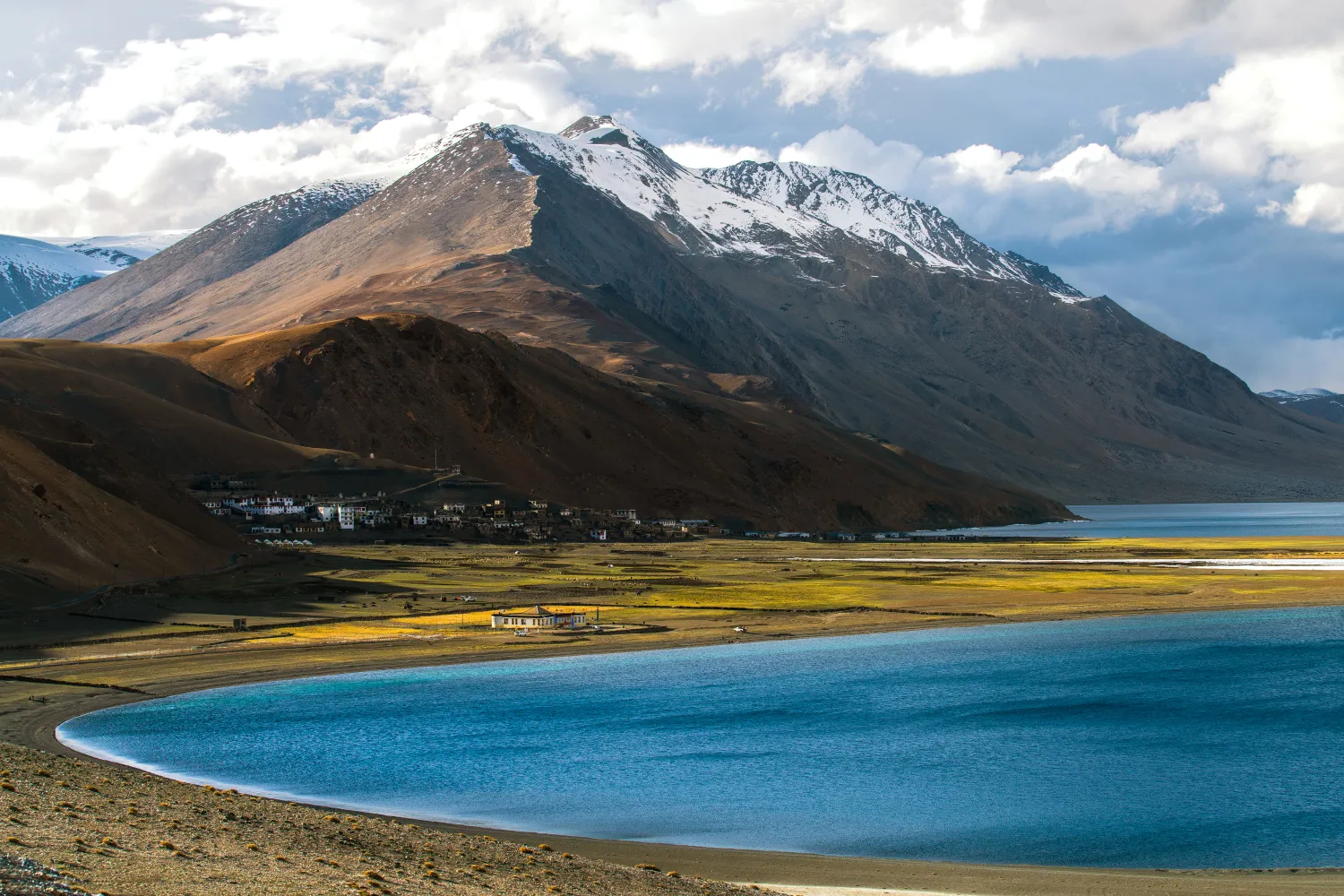
Rumtse to Tso Moriri Trek: Complete Ladakh Trail Guide
The Rumtse to Tso Moriri trek is an ~80 km, 7–8 day strenuous Ladakh trail crossing Kyamar La (~5,460 m) and Polokongka La (~5,190 m), ending at Tso Moriri Lake
Naranag Gangabal Trek: Complete Guide (2026)
The Naranag Gangabal Trek is a 4–5 day moderate-difficult alpine trek in Kashmir, covering ~26–30 km from Naranag (2,150 m) to Gangabal Lake (3,570 m).
Kolahoi Glacier Trek: Complete Kashmir Guide 2026
The Kolahoi Glacier Trek is a moderate-to-challenging 6-day route from Aru Valley near Pahalgam to Kashmir's largest glacier at 4,100 m.
Common questions answered
Yes. Indian passport holders can trek to K2 Base Camp in Pakistan with a valid Pakistani tourist visa and the required trekking permits (Gilgit-Baltistan Trek Permit, Baltoro Glacier Permit, Central Karakoram National Park entry fee, and a mandatory Liaison Officer). The trek is legally accessible and increasingly popular with Indian adventurers. However, India–Pakistan bilateral relations affect visa issuance: always check the latest MEA (Ministry of External Affairs, India) travel advisory and Pakistan High Commission visa status before committing to bookings. Pakistan visa process for Indian trekkers.
K2 Trek from India — Latest News
GB sees rise in foreign climbers, trekkers despite Mideast tensions
Gilgit-Baltistan experiences rising international trekker numbers, signalling improved conditions for K2 Trek expeditions from India despite regional geopolitic
The rise of organised trekking in India and the role of ‘Trek the Himalayas’ Untitled Story | Hindustan Times
The rise of organised trekking in India and the role of ‘Trek the Himalayas’ Untitled Story | Hindustan Times Hindustan Times
GB sees rise in foreign climbers, trekkers despite Mideast tensions
Gilgit-Baltistan reports rising international trekker numbers for K2 and other routes. Indian adventurers should book early and verify operator credentials.
Live Conditions
Real-time weather & trail status
Trail Conditions
Crowdsourced reports from trekkers who've done this route
Sign in to add a trip report
Find a Trek Buddy
Connect with trekkers planning the same route
No buddies yet for this trek
Sign in and be the first to post a planning signal.