Why Snow Leopard Trek Hemis is on every trekker's list
Few wildlife encounters on earth carry the weight of seeing a snow leopard in the wild. Referred to as the Ghost of the Mountains, the snow leopard is so perfectly camouflaged, so unhurried in its solitude, and so rarely seen that a single confirmed sighting can feel like a gift from the Himalayas themselves. Hemis National Park in Ladakh, India, is — without qualification — the finest place in the world to witness this moment.
Spanning approximately 4,400 sq km across the Zanskar and Ladakh ranges, Hemis is the largest national park in India and the largest notified protected area in South Asia. It sits at elevations ranging from roughly 3,500m to over 6,000m, sheltering one of the highest densities of wild snow leopards anywhere on the planet. During the peak winter trekking season, experienced guided groups in Rumbak Valley report snow leopard sighting success rates of 70–80%.
This guide covers everything you need to plan a snow leopard trek in Hemis for the 2026 trekking season: the best time to visit, a realistic 7-day itinerary, permit requirements, costs, packing essentials, safety guidance, and the frequently asked questions every first-timer has before heading into the Ladakhi winter.
Every year, wildlife photographers, naturalists, and adventurous trekkers fly into Leh from London, Tokyo, Melbourne, and Mumbai with a single purpose: to find a snow leopard in the wild. What draws them to Hemis specifically — rather than the savannahs of Kenya or the jungles of Ranthambhore — is the combination of raw Himalayan landscape, genuine wilderness, and a genuinely high probability of success.
Hemis is estimated to support one snow leopard per approximately 100–200 sq km within its core zones during winter — among the highest densities recorded globally. Compare that to most of the Tibetan Plateau or Central Asian ranges where a single individual may roam 500–1,000 sq km, and the significance becomes clear.
The region around Hemis is also part of the broader Ladakh Biosphere Reserve, which UNESCO recognises as a globally significant landscape for biodiversity conservation. Organisations including WWF India and the Snow Leopard Trust have conducted research and community-based conservation programmes here for decades, helping protect both the snow leopard and its prey base while providing livelihoods for local villages like Rumbak through wildlife tourism.
For trekkers accustomed to African safari formats — seated in a vehicle, scanning the bush — a snow leopard trek in Hemis is a fundamentally different experience. You walk. You sit for hours in sub-zero temperatures with spotting scopes trained on distant ridgelines. You learn to read pugmarks in fresh snow, interpret the alarm calls of bharal (blue sheep), and understand that patience is the primary skill required. When a snow leopard finally steps into view on a sunlit cliff above the Rumbak stream, the reward is incomparable.
How Many Snow Leopards Live in Hemis National Park?
Estimates suggest Hemis National Park harbours approximately 30–50 individual snow leopards, though precise counts vary by study and year. Camera trap surveys conducted in partnership with the Snow Leopard Trust have documented multiple individuals, including females with cubs, within the accessible trekking corridors of Rumbak Valley.
The park's prey base is robust: bharal (Himalayan blue sheep) are abundant across the valley slopes, supplemented by Himalayan ibex at higher elevations. This healthy prey density directly supports the snow leopard population and explains why Hemis leopards are relatively habituated to the presence of patient, respectful observers.
⚠️ Fact-check note: Population estimates of 30–50 individuals are based on available published surveys; the most recent camera trap census figures should be verified with the Hemis National Park authority or Snow Leopard Trust India before publication.
What Makes Hemis Better Than Other Snow Leopard Destinations?
India's other notable snow leopard trekking destinations — primarily Spiti Valley (Pin Valley National Park) and the village of Kibber — offer genuine sighting opportunities, but Hemis holds several structural advantages. The Rumbak Valley's topography channels snow leopards into a relatively compact, observable zone during winter. Local guides from Rumbak village have decades of experience tracking individual leopards by name. The homestay infrastructure in Rumbak, though basic, is established for winter visitors in a way that remote Spiti destinations are not.
Guided expeditions at Hemis deploy experienced naturalists who use high-powered spotting scopes (typically 60–80x magnification) to scan ridges up to 2–3 km away. This combination of terrain, expertise, and infrastructure makes Hemis the global benchmark for wild snow leopard tracking.
At a glance
Ask TrekSage about Snow Leopard Trek Hemis
Get instant answers grounded in verified trek data — beginner-friendliness, best months, permits, packing, and more.
The route at a glance
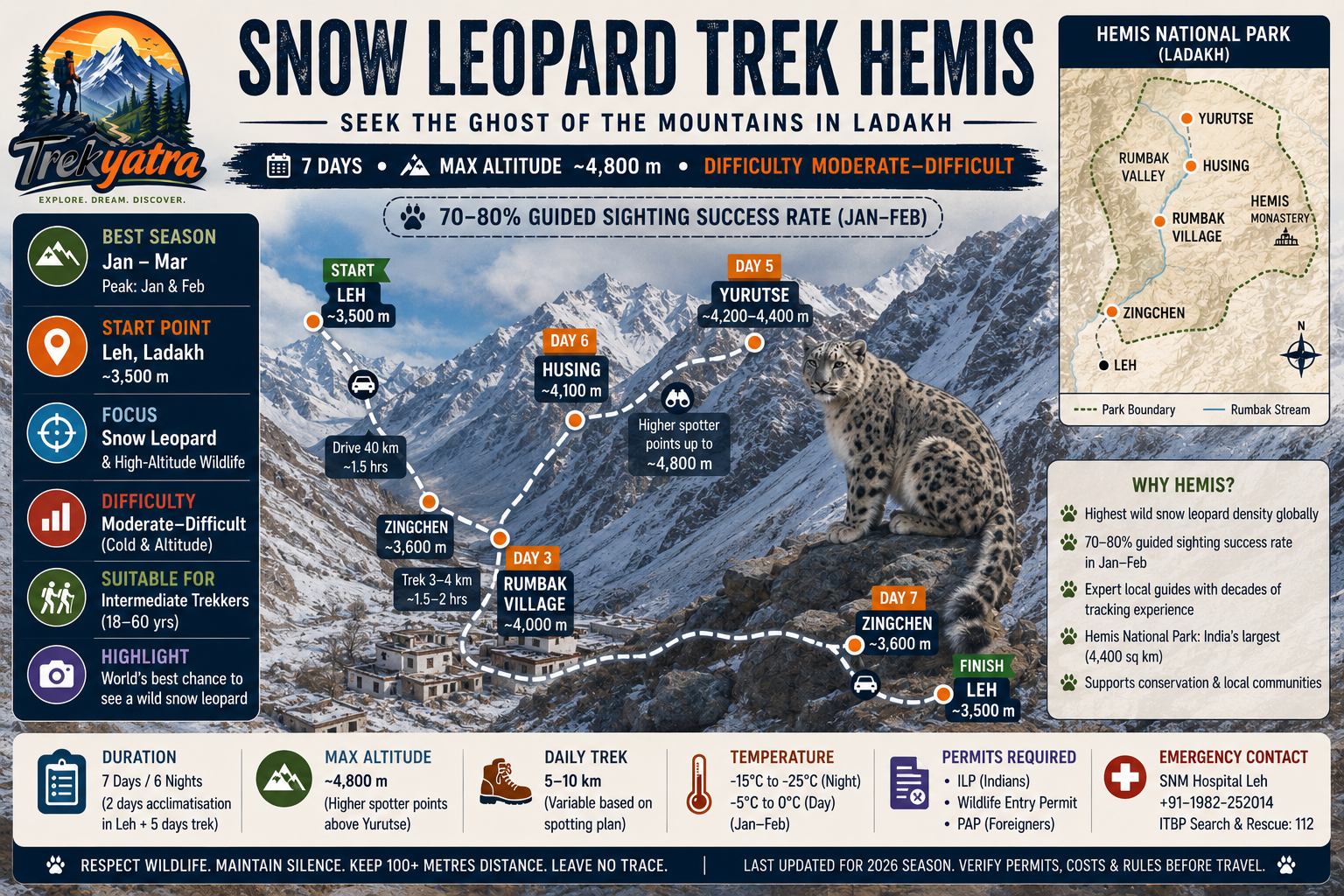
The snow leopard trek in Hemis is not a linear point-to-point route in the traditional sense. It is primarily a valley-based wildlife expedition centred on Rumbak Valley, with optional extensions toward Yurutse and Husing. The terrain is a mix of rocky, frozen riverbeds, snow-covered moraines, exposed ridges, and steep hillside paths — manageable for fit trekkers but demanding in winter conditions.
Elevation profile overview:
- Leh (base): ~3,500m
- Zingchen trailhead: ~3,600m
- Rumbak village: ~4,000m
- Husing: ~4,100m
- Yurutse: ~4,200–4,400m
- Higher spotter points: up to ~4,800m
The route from Zingchen to Rumbak village covers approximately 3–4 km on a defined trail (roughly 1.5–2 hours in winter conditions). Daily trekking within the valley for spotting covers 5–10 km depending on how far you push toward secondary zones.
The Markha Valley lies adjacent to this zone, and experienced trekkers sometimes extend their itinerary into Markha territory — though this is logistically complex in winter.
Key Trekking Zones Within Hemis National Park
Rumbak Village is the nucleus of the snow leopard trek. Sitting at approximately 4,000m, this small settlement of a few dozen households serves as the primary base. The slopes immediately above and around Rumbak — particularly the eastern ridge above the stream confluence — are the most reliably productive spotting zones. Local guides from Rumbak are integral to any serious sighting attempt; they know individual leopards' home ranges, preferred resting ledges, and current locations based on network communication with other villagers.
Husing is a smaller settlement roughly 2–3 km further up the valley from Rumbak, offering an alternative base with slightly higher elevation spotter points. It is frequently used as a day-extension from Rumbak.
Yurutse represents the upper limit of the comfortable winter trekking zone, at roughly 4,200–4,400m. The ridges here provide commanding views over multiple drainage systems — excellent for scanning with scopes. The terrain becomes more exposed and the cold more severe; proper layering is non-negotiable.
What each day actually looks like
This itinerary is designed for the January–February 2026 peak season. Acclimatisation in Leh before entering the park is mandatory and non-negotiable for safety.
Day 1 — Arrive Leh | Altitude: ~3,500m
Fly into Leh (Kushok Bakula Rimpochhe Airport). Rest completely for the remainder of the day. Avoid exertion, alcohol, and sleeping pills. Drink 3–4 litres of water. Brief orientation with your naturalist guide if on a package tour. Focus: Hydration, rest, acclimatisation.
Day 2 — Leh Acclimatisation | Altitude: ~3,500m
A second full day in Leh is strongly recommended for winter treks. Short, gentle walks to Leh Palace or Shanti Stupa (both easily accessible on foot from town). Gear check and permit collection. Briefing on snow leopard behaviour and spotting etiquette. Focus: Acclimatisation, preparation.
Day 3 — Leh to Rumbak Village | Altitude: ~4,000m
Drive from Leh to Zingchen (approximately 40 km, ~1.5 hours by private vehicle or shared taxi). Trek from Zingchen to Rumbak village: ~3–4 km, 1.5–2 hours on frozen trail. Check into homestay. Late afternoon: first spotting session on the slopes above the village with your guide and scope. Tip: Let your eyes adjust to the landscape. A snow leopard at rest on a grey cliff is almost invisible. Watch for the bharal — their behaviour signals predator presence.
Day 4 — Rumbak Valley Full-Day Spotting | Altitude: ~4,000–4,300m
This is the core day of the expedition. Depart the homestay before dawn (~6:30 AM) with packed lunch, thermos flasks, and layered clothing. Position at primary spotter points along the Rumbak stream valley by first light. Systematic ridge scanning continues until mid-afternoon. Return to Rumbak by 4 PM. Tip: Keep noise to an absolute minimum. Wear muted colours — avoid bright reds or blues. Success rates are highest on extended full days like this one.
Day 5 — Trek to Yurutse, Ridge Scanning | Altitude: ~4,200–4,400m
Early start from Rumbak. Trek to Yurutse (approximately 2–3 hours from Rumbak), scanning ridges en route. Yurutse's elevated vantage points allow scope coverage of broader terrain. Packed lunch at Yurutse. Return to Rumbak by late afternoon. Tip: The valley between Husing and Yurutse has recorded multiple kills in recent winters — the presence of vultures circling is a strong indicator of recent leopard activity.
Day 6 — Husing & Afternoon Buffer Spotting | Altitude: ~4,100m
Morning spotting session from above Rumbak, then walk to Husing for a change of vantage. If your group received a confirmed sighting on Day 4 or 5, your naturalist may recommend returning to the same zone — leopards often hold territory around a kill for 3–5 days. This buffer day frequently yields the closest sightings of the trip for patient groups. Afternoon return to Rumbak homestay.
Day 7 — Return to Leh | Altitude: descent to ~3,500m
Early morning final spotting session from Rumbak village slopes (leopards are most active at dawn). Trek back to Zingchen by mid-morning. Drive to Leh (approximately 1.5 hours). Debrief with naturalist. Tip: Even the drive back to Leh through the Indus Valley occasionally yields sightings of golden eagle and Himalayan griffon vulture.
When to go
The single most important factor in planning a snow leopard trek in Hemis is timing. Get it right and your chances are genuinely excellent. Get it wrong and you may spend a week in a frozen valley seeing little but the spectacular (but snow-leopard-free) Ladakhi winter landscape.
Peak season: January and February. Winter snowfall drives snow leopards — and their prey, particularly bharal — from higher elevations (above 4,500m in summer) down into the accessible valley systems around 3,800–4,200m. This is when Rumbak Valley becomes a productive hunting ground for leopards and a productive spotting ground for trekkers. January and February temperatures drop to -15°C to -25°C at night and may reach -5°C to 0°C during sunny midday hours. Daylight runs approximately 9–10 hours per day.
Secondary windows: Late December and early March. Snow leopard activity is building in late December and winding down through March, but sightings remain reasonable. Weather variability is higher at both ends of this window.
Summer (April–November): Not suitable for snow leopard trekking. As snow melts, leopards retreat above 4,500m where the terrain is inaccessible without technical mountaineering equipment and where their grey-spotted coats render them essentially invisible against the rocky alpine landscape.
Cultural note: If you visit Ladakh in summer, the Hemis Festival (typically June–July, dates confirmed annually) is an extraordinary Tibetan Buddhist celebration at Hemis Monastery — but it is not a snow leopard watching event.
Month-by-Month Snow Leopard Sighting Probability
| Month | Sighting Probability | Notes |
|---|---|---|
| December (late) | Moderate | Leopards moving down, snow accumulating |
| January | High | Peak activity; fresh snow reveals pugmarks; bharal concentrated in lower valleys |
| February | Highest | Maximum leopard presence in accessible zones; 70–80% guided success rate |
| March (early) | Moderate-High | Snow beginning to melt; leopards starting to move higher |
| March (late) | Moderate | Declining success as leopards ascend |
| April–November | Low to nil | Leopards above accessible altitudes for most trekkers |
Is this trek right for you?
The snow leopard trek in Hemis is rated Moderate-Difficult, but importantly, the challenge is not technical. There is no rock climbing, rope work, or glacier travel involved. The difficulty is driven by two factors: extreme winter cold and high altitude.
Trekkers should be comfortable walking 8–12 km per day on uneven, snowy terrain at elevations between 3,800m and 4,400m. The cold is relentless — experienced trekkers describe the combination of sitting still for hours on a frozen hillside while scanning with binoculars as more physically demanding than the walking itself.
Recommended fitness: 6–8 weeks of prior cardio training (running, cycling, stair climbing). If possible, train in cold conditions. Some prior high-altitude trekking experience (above 3,000m) is strongly advised.
Age suitability: Generally 18–60, though healthy, fit individuals outside this range have completed the trek. Medical clearance is advised for anyone with a history of heart or respiratory conditions. The trek is not suitable for those with uncontrolled hypertension, asthma, or cardiac conditions.
Acute Mountain Sickness (AMS) is the primary medical risk. Two full days of acclimatisation in Leh before entering the park is non-negotiable. Carry Diamox (acetazolamide) as prescribed and understand AMS symptoms.
What permits you need
This section contains mandatory regulatory information. Permit rules and fees can change. Verify current requirements with the Leh District Collectorate or your registered trek operator before travel.
Indian Nationals require:
1. Inner Line Permit (ILP): Approximately INR 400 per day for Indian nationals in 2026
2. Wildlife Entry Permit for Hemis National Park: Obtained at the Leh District Collectorate (DC Office) or via a registered tour operator
Foreign Nationals additionally require:
3. Protected Area Permit (PAP): Approximately USD 10–15 per day in 2026
Where to obtain permits:
- Leh District Collectorate (DC Office), Leh town — in person
- Ladakh Tourism online portal (check current availability for 2026 season)
- Via your registered trek operator (recommended — they handle the paperwork)
Documents required: Valid passport or Aadhaar card, recent passport-size photographs, trek itinerary, operator registration details
Processing time: Same-day processing typically available at DC Office; allow extra time during peak January–February season
Guide/naturalist requirements: Licensed naturalists accompanying groups into Hemis must hold relevant permits issued by the park authority. Verify your operator's naturalist credentials.
What this trek will cost you
Guided Package (Strongly Recommended)
A full 7-day guided snow leopard expedition with a reputable operator — including accommodation in Rumbak homestays, all meals, a certified wildlife naturalist, return transport from Leh, all permits, and spotting equipment — typically costs:
INR 45,000–75,000 per person (2026 estimate, based on groups of 4–8)
The higher end of this range reflects premium operators with smaller group sizes, experienced naturalists, and better quality gear support. For a wildlife expedition where sighting success is directly correlated with the quality of your guide and naturalist, this is money well spent.
DIY Budget Estimate (7 Days, Excluding Flights to Leh)
| Item | Estimated Cost |
|---|---|
| Transport: Leh to Zingchen (private taxi) | INR 2,000–3,500 |
| Rumbak village homestay | INR 500–800 per night |
| Local guide from Rumbak | INR 1,500–2,000 per day |
| Permits (ILP + Wildlife Entry, Indian) | INR 400–800 per day |
| Meals (homestay + packed lunch) | INR 300–500 per day |
| Sleeping bag rental (if not owned) | INR 200–400 per day |
| Crampons rental | INR 150–300 per day |
| Total DIY estimate (7 days) | INR 20,000–35,000 |
Note: DIY trekkers without a professional naturalist will have significantly lower sighting success rates. A local Rumbak guide is not a substitute for a trained wildlife naturalist with high-powered spotting scopes.
Recommended Tour Operators for the Snow Leopard Trek in Hemis
When selecting an operator, prioritise: certified naturalists, small group sizes (maximum 8 persons), and operators who contribute a conservation fee to local Rumbak community funds or Snow Leopard Trust programmes.
- Rimo Expeditions (Leh): One of Ladakh's most established adventure operators with documented snow leopard expedition experience
- Himalayan Ibex (Leh): Specialises in Hemis wildlife expeditions with local naturalist partnerships
- Aquaterra Adventures (Delhi/Leh): Nationally known operator with a wildlife department and certified naturalist team
⚠️ Operator details should be independently verified — contact details, availability, and pricing for 2026 should be confirmed directly with each operator. TrekYatra does not guarantee current operational status.
What to pack
Clothing
- Merino wool or synthetic base layer (top and bottom) — minimum 2 sets
- Mid-layer fleece or down sweater
- Down jacket rated to at least -20°C — this is non-negotiable for Rumbak winter nights
- Waterproof and windproof outer shell (jacket and trousers)
- Balaclava and warm hat
- Insulated gloves + liner gloves
- Neck gaiter
- Gaiters (for snow)
- Insulated waterproof boots — rated to at least -20°C
- Warm trekking socks (wool) — minimum 4 pairs
Equipment
- Trekking poles with winter baskets
- Crampons or microspikes (available for rent in Leh)
- Headlamp + spare batteries
- Binoculars minimum 10x42 — essential even if your group has a spotting scope
- Spotting scope (60–80x) — provided by most guided operators; essential for self-guided groups
- Thermos flask (2L minimum)
- Sunglasses (UV400, glacier-rated)
- Trekking backpack (25–35L for day pack)
Camera Gear
- Telephoto lens 400mm minimum (500mm+ preferred for snow leopard photography)
- Spare batteries — cold kills batteries rapidly; keep spares in inner jacket pocket
- Hand warmers for battery packs — essential in temperatures below -10°C
- Memory cards
- Camera bag with insulation
Documents
- Inner Line Permit (original + copies)
- Protected Area Permit (foreign nationals)
- Wildlife Entry Permit for Hemis
- Passport / Aadhaar card
- Travel insurance documentation (with emergency evacuation cover)
- Emergency contact card
Medications
- Diamox (acetazolamide) — consult your doctor before travel; standard AMS prevention
- Ibuprofen or paracetamol
- Blister treatment kit
- Rehydration salts
- Throat lozenges (dry Ladakhi air is harsh)
- Personal prescription medications with extra supply
Staying safe on the mountain
Altitude Sickness
Acute Mountain Sickness (AMS) is the most serious routine risk on this trek. Spend a minimum of 2 full days acclimatising in Leh before trekking into Rumbak. Know the symptoms of AMS (headache, nausea, dizziness, fatigue), HACE (High Altitude Cerebral Oedema — confusion, loss of coordination), and HAPE (High Altitude Pulmonary Oedema — breathlessness at rest, pink frothy cough). If any symptoms of HACE or HAPE appear, descend immediately.
Emergency medical facility: SNM Hospital Leh (District Hospital) — +91-1982-252014. The hospital has limited high-altitude medicine facilities; severe cases may require helicopter evacuation to Chandigarh or Delhi.
The ITBP (Indo-Tibetan Border Police) operates search and rescue capability in Ladakh — your operator should carry their contact information.
Hypothermia and Frostbite
At -20°C with wind chill, exposed skin can develop frostbite within minutes. Keep all skin covered. Watch for frostbite warning signs: numbness, white or greyish-yellow skin, waxy or hard texture. Never rub frostbitten skin. Rewarm gently. Hypothermia (shivering, confusion, slurred speech) requires immediate warming and descent.
Do Not Trek Solo in Winter
Never attempt a solo winter trek into Hemis National Park. Trail conditions, snow, and extreme cold create genuine survival risk without experienced local guidance.
Wildlife Safety
If you encounter a snow leopard at close range (extremely rare), maintain a minimum 100-metre distance. Do not pursue, corner, or cut off the animal's escape route. Your naturalist guide will manage all wildlife interactions. Respect the park's wildlife viewing code.
Travel Insurance
Emergency evacuation insurance is mandatory, not optional. Ensure your policy explicitly covers high-altitude trekking and helicopter evacuation from Ladakh.
Similar treks to explore
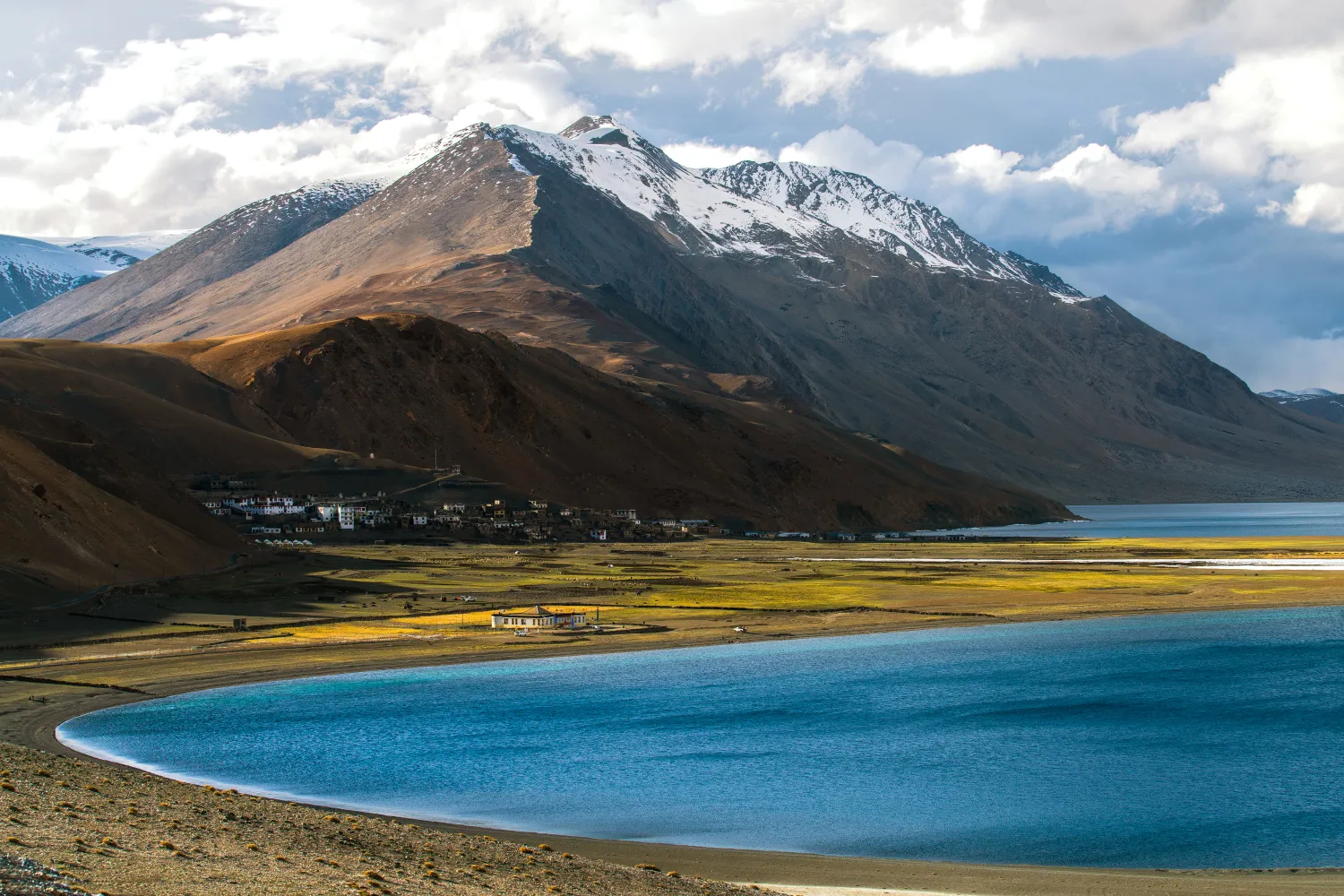
Rumtse to Tso Moriri Trek: Complete Ladakh Trail Guide
The Rumtse to Tso Moriri trek is an ~80 km, 7–8 day strenuous Ladakh trail crossing Kyamar La (~5,460 m) and Polokongka La (~5,190 m), ending at Tso Moriri Lake
Naranag Gangabal Trek: Complete Guide (2026)
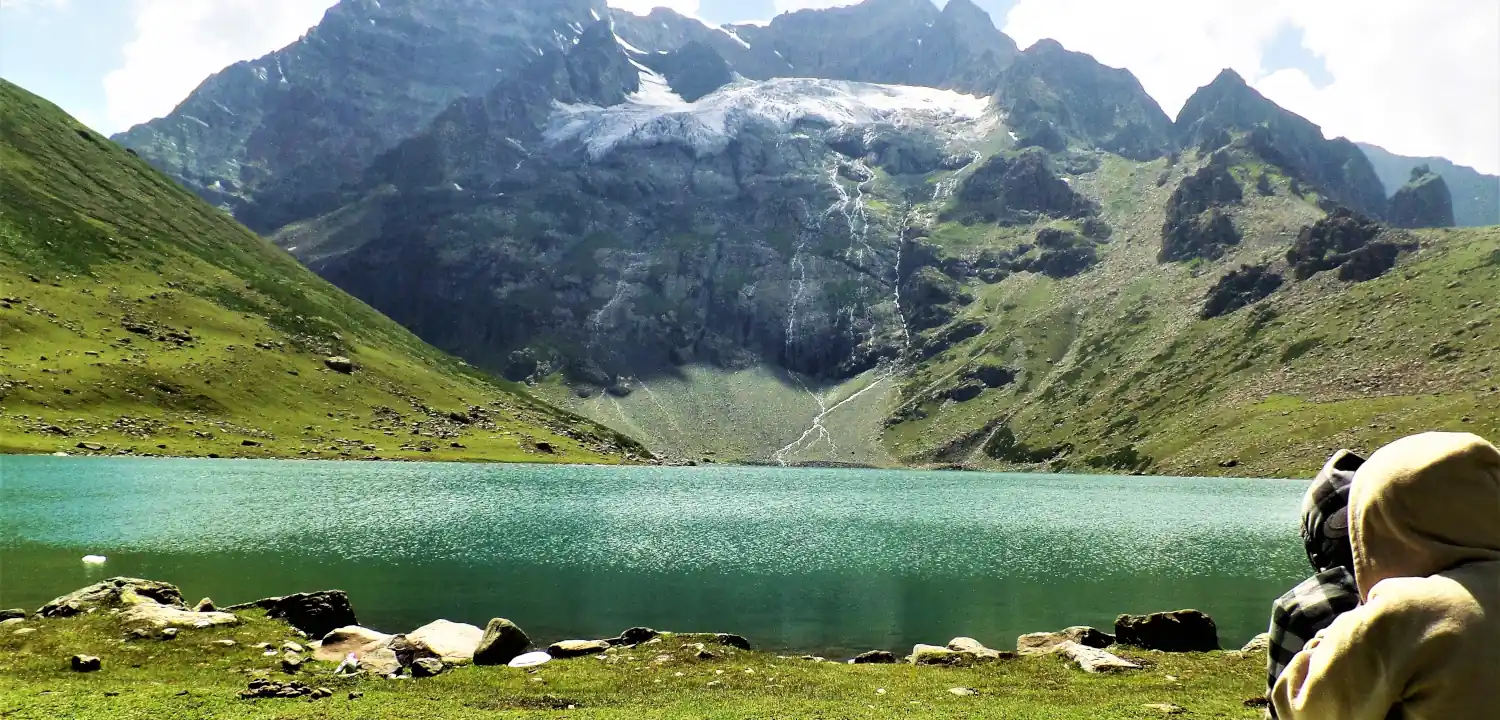
The Naranag Gangabal Trek is a 4–5 day moderate-difficult alpine trek in Kashmir, covering ~26–30 km from Naranag (2,150 m) to Gangabal Lake (3,570 m).
Kolahoi Glacier Trek: Complete Kashmir Guide 2026
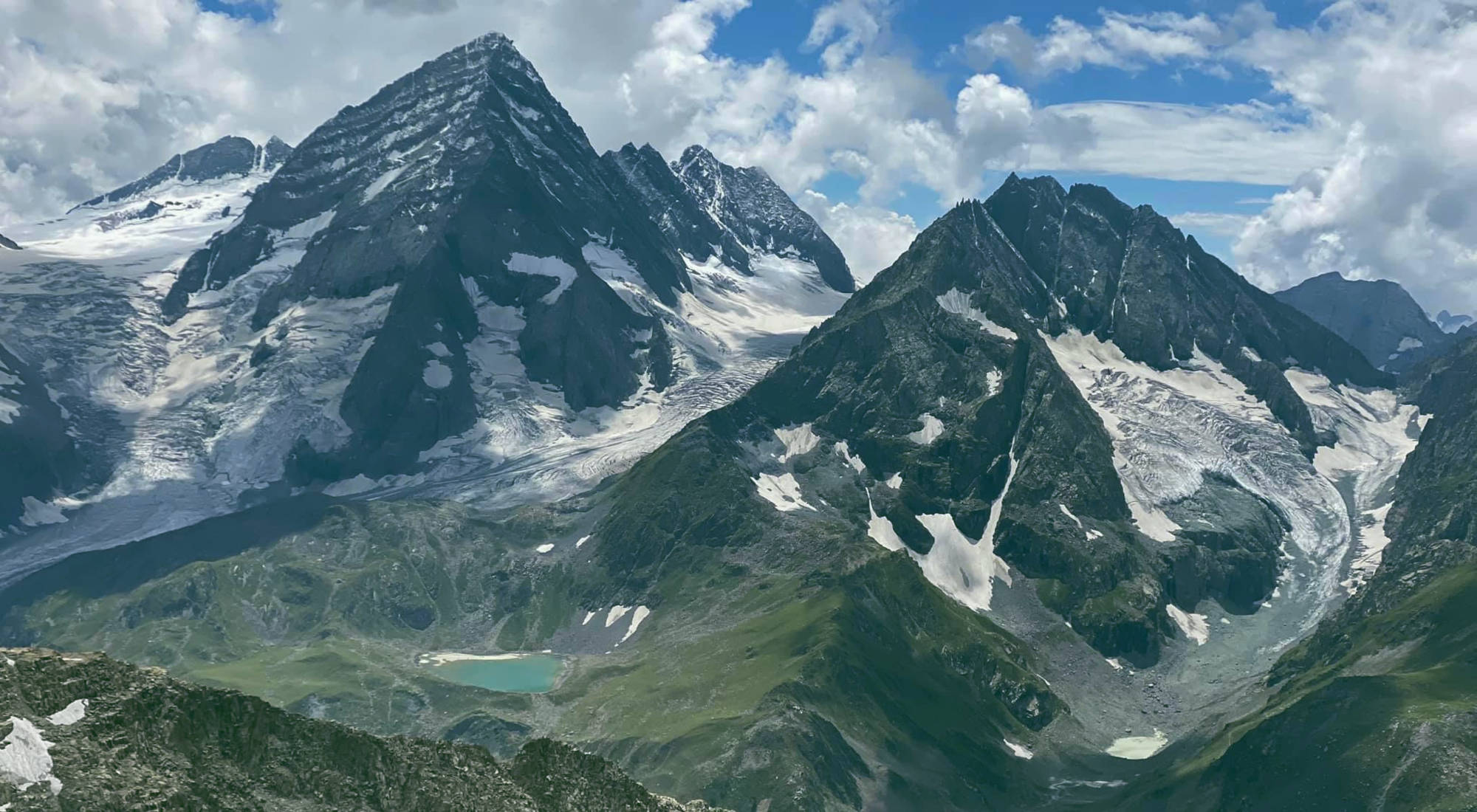
The Kolahoi Glacier Trek is a moderate-to-challenging 6-day route from Aru Valley near Pahalgam to Kashmir's largest glacier at 4,100 m.
Common questions answered
The highest sighting probability is in January and February, when accumulated snowfall pushes snow leopards and their prey (particularly bharal) down to lower, accessible elevations in Rumbak Valley. Late December and early March offer reasonable secondary windows with somewhat lower success rates. The rest of the year, snow leopards retreat above 4,500m and are effectively inaccessible and invisible to non-technical trekkers.
Snow Leopard Trek Hemis — Latest News
Hemis National Park: How to reach, when to go and everything traveller should know before visiting?
Hemis National Park: How to reach, when to go and everything traveller should know before visiting? The Times of India
Snow Leopard Trekking in Ladakh Ranks 4th on Wildlife Experience Index
Snow Leopard Trek Hemis in Ladakh achieves 4th ranking on Wildlife Experience Index, validating it as a premier wildlife trekking destination with exceptional s
Hemis National Park: How to reach, when to go and everything traveller should know before visiting?
Hemis National Park: How to reach, when to go and everything traveller should know before visiting? The Times of India
Live Conditions
Real-time weather & trail status
Trail Conditions
Crowdsourced reports from trekkers who've done this route
Sign in to add a trip report
Find a Trek Buddy
Connect with trekkers planning the same route
No buddies yet for this trek
Sign in and be the first to post a planning signal.