
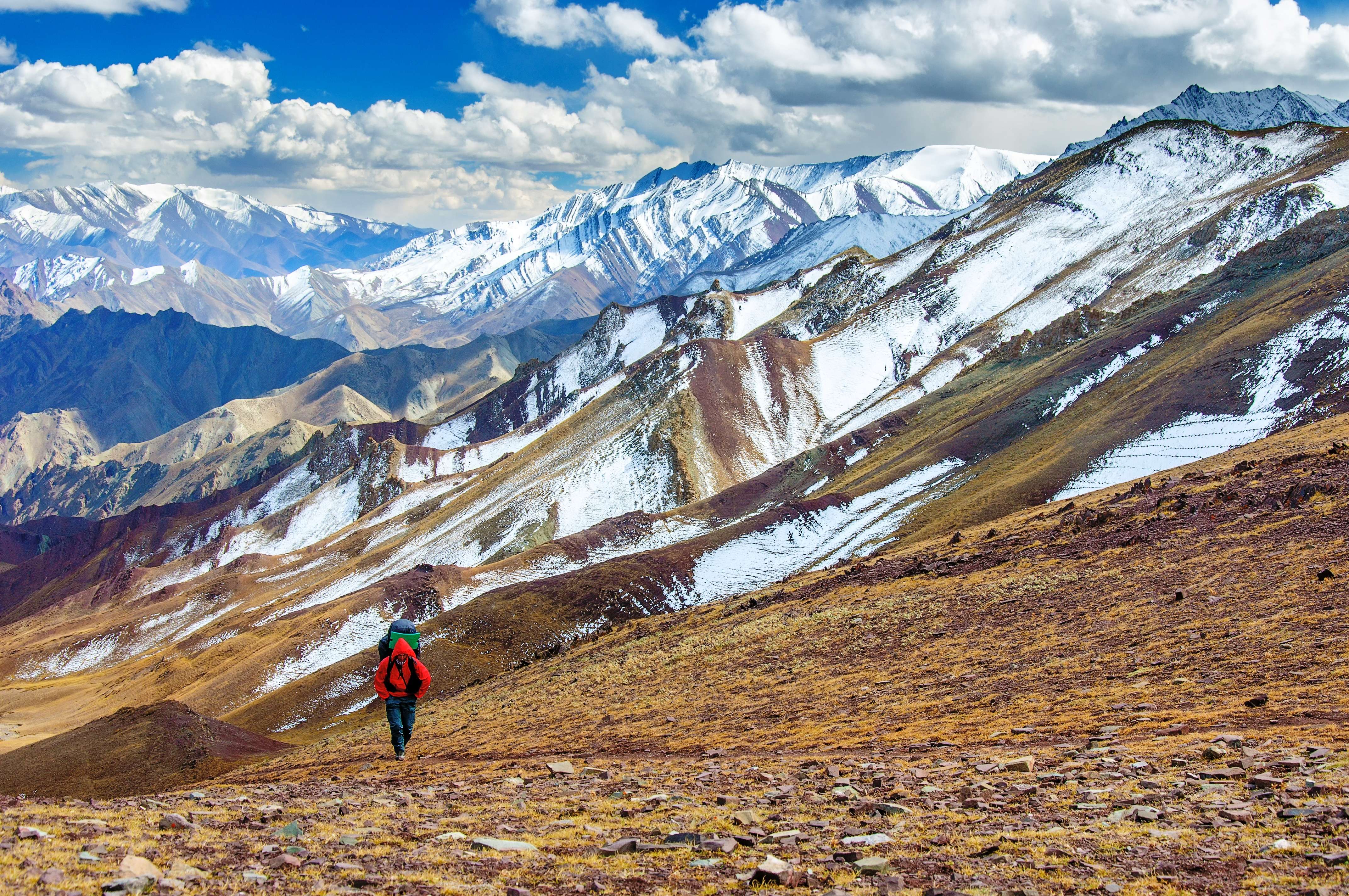
Why Markha Valley Trek is on every trekker's list
Few treks in the Indian Himalaya earn the word iconic as honestly as the Markha Valley trek. Cutting deep into the heart of Ladakh, this 65–80 km trail winds past whitewashed monasteries, through river gorges carved by the Zanskar River, and over one of the highest trekking passes in the region — Kongmaru La at 5200m — before descending back toward Leh. Villages like Skiu, Markha, Hankar, and Nimaling feel genuinely remote, connected to the outside world more by tradition than tarmac.
The elevation range runs from roughly 3150m at Chilling to 5200m at Kongmaru La, covering that altitude band in a steady, well-graded ascent over 7–9 days depending on your chosen route. Along the way, expect jaw-dropping views of Kang Yatze (6400m+), encounters with bharal (blue sheep) on the high ridges, and — if luck is on your side — possible glimpses of the elusive snow leopard inside Hemis National Park.
This 2026 guide is written for the 2026 trekking season and reflects current permit regulations, cost estimates, and logistical realities as accurately as possible.
Ladakh is spoiled for trekking options — so what makes Markha Valley stand out among the best treks in Ladakh?
Landscape variety: In a single week you'll walk through Zanskar River gorges, open barley fields, high-desert plateaus, and alpine meadows — a cinematic shift of scenery that few treks in India can match.
Cultural depth: The valley is dotted with functioning Ladakhi villages where families still farm barley and raise yaks. Spending a night in a homestay in Markha village — sharing butter tea and tsampa with a local family — is the kind of experience you don't forget.
Wildlife: The trek passes through Hemis National Park, home to the highest density of snow leopards in the world. Bharal herds are a near-daily sighting above 4000m.
Relative remoteness: Unlike the Chadar trek (winter, heavily organised) or the Stok Kangri climb (technical), the Markha Valley trail rewards self-sufficient trekkers who want genuine wilderness without requiring technical mountaineering skills.
A trekker's perspective: "The Markha Valley changed how I understand Ladakh. You see the mountains, but you also see the people who live inside them." — a sentiment echoed by hundreds of TrekYatra community members who rate this among their top three Himalayan experiences.
For broader context on trekking in the region, see our Ladakh trekking guide.
At a glance
Ask TrekSage about Markha Valley Trek
Get instant answers grounded in verified trek data — beginner-friendliness, best months, permits, packing, and more.
The route at a glance
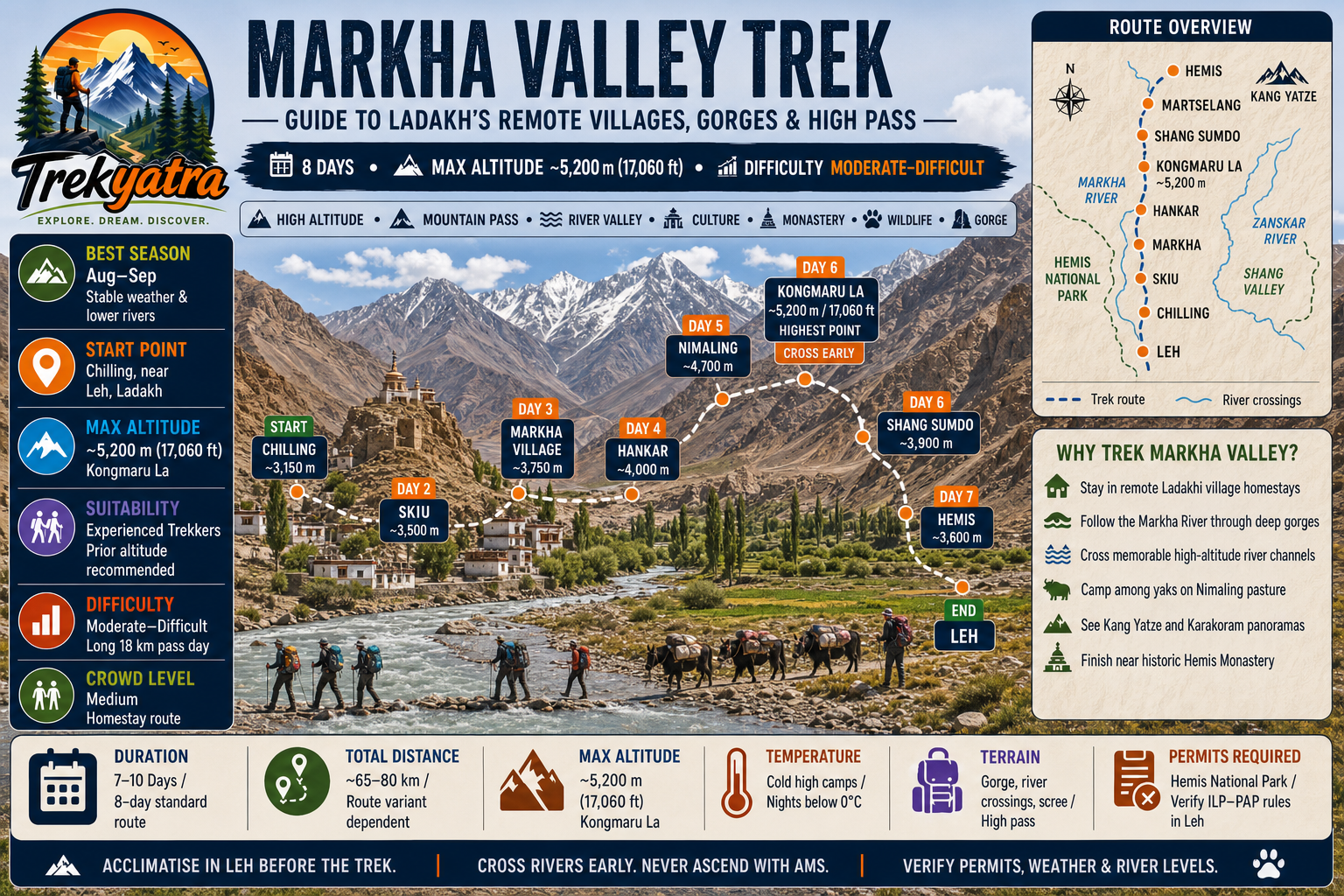
Two main routes access the Markha Valley, both ending at Hemis Monastery near Leh.
- Chilling–Hemis route: ~65 km, 7–8 days, the most popular option
- Spituk–Hemis route: ~80 km, 9–10 days, the longer classic variant
Key waypoints on either route include: Chilling → Skiu → Markha village → Hankar → Nimaling → Kongmaru La (5200m) → Shang Sumdo → Martselang → Hemis.
River crossings are a defining feature of the route. The Markha River is crossed multiple times between Skiu and Hankar; crossing difficulty varies dramatically with snowmelt — early June crossings can be knee-to-thigh deep, while September crossings are typically ankle-deep. Never underestimate a mountain river.
Chilling to Hemis Route
The Chilling–Hemis route is the standard choice for the 2026 trekking season. The trailhead at Chilling is roughly 35 km from Leh along the Leh–Nimmu–Chilling road, accessible by shared taxi or private vehicle in approximately 1.5–2 hours.
At Chilling, you cross the Zanskar River via a rope-bridge (locally called a jhula) — a short but memorable introduction to the valley. From here the trail follows the Markha River upstream through a steadily widening gorge, with gradual altitude gain that aids acclimatisation. The Chilling start is preferred precisely because the altitude profile is gentler in the first two days, giving your body time to adjust before the big push to Nimaling and Kongmaru La.
This is also the most straightforward route for trekkers arriving in Leh with limited time. For route context within the wider region, see our Leh Ladakh travel guide.
Spituk to Hemis Route (Longer Variant)
The Spituk–Hemis route adds approximately two days by starting at Spituk on the outskirts of Leh itself (near Leh airport), traversing the Stok range before dropping into the Markha Valley. It passes close to the Stok Kangri base camp area, making it an excellent precursor or alternative to the Stok Kangri trek.
The longer approach provides superior acclimatisation — you spend more days at intermediate altitudes before committing to Nimaling and the Kongmaru La crossing. For this reason, first-time high-altitude trekkers are strongly encouraged to consider the Spituk start, especially if they have arrived in Leh within the past 2–3 days and feel any residual breathlessness.
The trade-off is an extra two days of trekking and slightly higher logistical complexity at the Spituk end.
What each day actually looks like
The following is TrekYatra's recommended 8-day standard itinerary using the Chilling–Hemis route.
Day 1 — Leh (3524m): Acclimatisation
Arrive in Leh. Spend the day resting, hydrating, and making short local walks. Visit Leh Palace or Shanti Stupa — both low-exertion activities that help your body adjust. Avoid alcohol. Confirm permits (see Permits section below).
Day 2 — Drive Leh → Chilling; Trek Chilling → Skiu (~10 km, 3150m → 3500m)
Early morning drive to Chilling (~1.5–2 hrs). Cross the Zanskar River rope-bridge and begin trekking up the Markha gorge. The trail is well-defined through rocky canyon terrain. Reach Skiu village by afternoon. Camp or homestay at Skiu (3500m).
Day 3 — Skiu → Markha Village (~14 km, 3500m → 3750m)
A longer day through widening valley with multiple Markha River crossings (ankle-to-knee depth in August–September). Pass ruined fortifications. Markha village has a small gompa and several homestays. Camp or homestay at Markha (3750m).
Day 4 — Markha → Hankar (~10 km, 3750m → 4000m)
Shorter day with steady altitude gain. The Kang Yatze massif comes into full, dramatic view from Hankar. Rest in the afternoon to acclimatise to 4000m+. Hankar has basic homestays. Camp or homestay at Hankar (4000m).
Day 5 — Hankar → Nimaling (~12 km, 4000m → 4700m)
The valley opens into high alpine meadow as you climb to Nimaling, the highest campsite on the trek. This is yak-grazing country; herders' tents are often visible. Camping only at Nimaling — no permanent structures. The altitude demands a slow, steady pace. Camp at Nimaling (4700m).
Day 6 — Nimaling → Kongmaru La → Shang Sumdo (~18 km, 4700m → 5200m → 3900m)
The biggest day on the trek. Pre-dawn or early morning start recommended to cross Kongmaru La (5200m) before afternoon winds and potential thunderstorms build. The ascent from Nimaling is steep but clearly marked. On a clear day, views extend to Karakoram peaks. Long descent to Shang Sumdo. Camp at Shang Sumdo (3900m).
Day 7 — Shang Sumdo → Martselang / Hemis (~12 km, 3900m → 3600m)
Relatively easy descent through the Shang Valley. Trail passes scattered settlements. Reach Martselang or continue to Hemis Monastery road-head. Overnight at Martselang or Hemis guesthouse (3600m approx.).
Day 8 — Drive Hemis → Leh (~45 km road)
Morning vehicle pickup from Hemis. Visit Hemis Monastery en route if time permits. Return to Leh by midday. Trek complete.
Altitude Profile & Camp Elevations
| Campsite / Waypoint | Altitude |
|---|---|
| Chilling (trailhead) | 3150m |
| Skiu | 3500m |
| Markha Village | 3750m |
| Hankar | 4000m |
| Nimaling | 4700m |
| Kongmaru La (pass) | 5200m |
| Shang Sumdo | 3900m |
| Martselang / Hemis | ~3600m |
When to go
The 2026 trekking season follows established seasonal patterns. Here is what to expect month by month:
June–July: The valley is green and wildflowers bloom at Nimaling — visually stunning. However, Kongmaru La may carry significant residual snow in early June, and river crossings run high and fast from snowmelt. Late June to mid-July is manageable but demands caution. Afternoon thunderstorms are more frequent.
August–September (Peak Season): This is the sweet spot — reliable weather, lower rivers, clear passes. Expect the trail to be at its busiest, especially in August. Tea houses and homestays fill up; book ahead where possible.
October: Crisp, vivid skies and dramatic light for photography. Rivers drop to their lowest. Nights at Nimaling can drop to -10°C or below, so cold-weather gear is essential. Crowds thin considerably after the first week of October. Mid-October sees the season wind down rapidly.
November–May (Closed Season): Kongmaru La becomes impassable under snow. Temperatures at Nimaling routinely fall to -25°C or lower. This is not a route for general trekkers in winter. The Markha Valley in winter is specialist territory only.
TrekYatra Recommendation: August to mid-October is the ideal window for most trekkers in 2026. First-timers should target August–September for the most forgiving conditions.
For a broader seasonal breakdown of Ladakh, see our best time to visit Ladakh guide.
Is this trek right for you?
Overall rating: Moderate–Challenging.
The Markha Valley trek is not a beginner trail, but it is well within reach for anyone who prepares properly. Key physical demands:
- Longest single day: ~18 km (Nimaling to Shang Sumdo via Kongmaru La)
- Highest point: Kongmaru La at 5200m — above the altitude threshold where AMS becomes a serious risk for unacclimatised trekkers
- River crossings: Multiple crossings of the Markha River, some knee-deep in peak season
- Terrain: Rocky river-bed trails, loose scree on the Kongmaru La ascent, exposed ridgelines
Fitness preparation: Begin cardio training (running, cycling, stair climbing) at least 8 weeks before the trek. Incorporate loaded day hikes carrying 8–10 kg progressively in the final 4 weeks. Prior experience at altitude above 4000m is strongly recommended. This trek is not suitable for complete beginners with zero altitude experience.
For comprehensive high-altitude fitness guidance, see our high-altitude trekking tips.
What permits you need
Two permits are mandatory for the Markha Valley trek in 2026. Do not attempt this route without both.
1. Inner Line Permit (ILP)
- Required for: All trekkers, Indian and foreign nationals
- Cost (Indian nationals): Free of charge
- Cost (Foreign nationals): Approximately ₹400 per person
- Where to obtain: Online via the Leh District Collectorate e-portal, or in person at the DC Office, Leh. Checkpost collection is also possible but can cause delays.
- Documents required: Valid government-issued photo ID (Aadhaar/passport), two passport-size photographs
- Processing time: Online applications are typically approved within 24–48 hours
2. Hemis National Park Wildlife Permit
- Required for: All trekkers entering Hemis National Park (covers most of the Markha Valley route)
- Cost (Indian nationals): ₹25 per day
- Cost (Foreign nationals): ₹100 per day
- Where to obtain: At the Hemis National Park entry checkpost (Chilling/Skiu area) or in advance at the Wildlife Protection Department office in Leh
- Documents required: Copy of ILP, valid photo ID
Guided groups: If booking through a registered trekking operator, they will typically arrange both permits on your behalf — confirm this explicitly when booking.
What this trek will cost you
DIY Cost Breakdown (Per Person, 8 Days, 2026)
| Expense | Estimated Cost (INR) |
|---|---|
| Transport Leh–Chilling–Leh (shared/private taxi) | ₹2,000–₹3,500 |
| Inner Line Permit (Indians) | Free |
| Hemis National Park permit (8 days, Indians) | ₹200 |
| Camping/homestay per night (7 nights) | ₹500–₹1,500/night = ₹3,500–₹10,500 |
| Meals on trail (breakfast + lunch + dinner) | ₹300–₹600/day = ₹2,400–₹4,800 |
| Guide (optional, highly recommended) | ₹1,200–₹1,800/day |
| Horseman/porter (optional) | ₹1,500–₹2,500/day |
Total DIY estimate (without guide/porter): ₹8,000–₹19,000
Total DIY estimate (with guide, no porter): ₹12,000–₹20,000
Guided Package Cost
All-inclusive 8-day guided packages from Leh (accommodation, meals on trek, guide, horseman, permits, transport): ₹18,000–₹35,000 per person depending on group size, operator, and level of service.
DIY vs. Guided Package: Which Is Better?
DIY suits experienced high-altitude trekkers who are confident with navigation, carry their own camping gear, and want maximum flexibility. The trail is reasonably well-marked in the lower sections, and community homestays reduce the need for a full camping setup. However, navigation around Kongmaru La in poor visibility is genuinely challenging, and DIY trekkers have no backup if something goes wrong above 4500m.
Guided package adds real value in three specific situations: (1) first-time high-altitude trekkers who need someone to monitor AMS symptoms, (2) solo trekkers who want a safety net at river crossings and the high pass, and (3) trekkers who prefer the logistics handled so they can focus entirely on the experience.
Our take: Hiring a local guide (even if not booking a full package) is strongly recommended for first-timers. A knowledgeable Ladakhi guide also adds enormous cultural context to the villages you pass through.
What to pack
For a full gear breakdown, see our dedicated Ladakh packing list. Key items for the Markha Valley trek:
Clothing
- Thermal base layers (top and bottom) × 2
- Fleece mid-layer
- Down jacket (800-fill or equivalent — essential at Nimaling)
- Waterproof/windproof shell jacket and trousers
- Trekking trousers × 2
- Lightweight gaiters (river crossings + scree)
- Warm hat, sun hat, buff/neck gaiter
- Trekking gloves + liner gloves
- Moisture-wicking trekking socks × 5–6 pairs
Footwear
- High-ankle waterproof trekking boots (broken in before the trek)
- Camp sandals/flip-flops for evenings
Gear
- Trekking poles (critical for river crossings and Kongmaru La descent)
- Headlamp + spare batteries
- Sleeping bag rated to -10°C (mandatory for Nimaling)
- Trekking tent (if camping independently; not needed if using homestays + camping at Nimaling only)
- 45–55L trekking backpack + rain cover
- Dry bags for electronics and sleeping bag
Navigation
- Offline maps downloaded (Maps.me or Gaia GPS; Markha Valley trail is available on both)
- Compass
- Printed permit copies as backup
Health & First Aid
- Diamox (Acetazolamide) — consult your doctor before the trek; widely recommended for AMS prevention above 3500m
- Ibuprofen/paracetamol
- Blister kit and zinc oxide tape
- Water purification tablets or SteriPen
- Sunscreen SPF 50+ (UV intensity at altitude is extreme)
- Lip balm with SPF
- Personal prescription medications
Documents
- Both permits (printed + digital copies)
- Valid government ID / passport
- Travel insurance documents (policy number + emergency contact)
- Emergency contact list
Staying safe on the mountain
The Markha Valley is remote. Mobile network coverage disappears almost entirely once you leave Chilling. Here is what to take seriously:
Acute Mountain Sickness (AMS): Classic symptoms — persistent headache, nausea, loss of appetite, dizziness — can develop at any altitude above 3000m but become significantly more dangerous above 4500m. The only correct response to worsening AMS is immediate descent. Never ascend with AMS symptoms. Diamox can help with prevention and mild symptoms but is not a cure — discuss with a doctor before your trek.
Hydration: Drink 3–4 litres of water per day on the trail. Dehydration at altitude worsens AMS symptoms dramatically. Always purify water from streams.
River crossings: Unbuckle your pack hip belt before any river crossing so you can shed your pack if you fall. Use trekking poles for stability. Cross at the widest, shallowest point. Never cross swollen rivers in the dark or after heavy rain upstream.
Weather: Afternoon thunderstorms are common in July and August. Plan to reach your campsite by early afternoon. If caught in lightning above treeline (i.e., everywhere above Chilling), move off ridges and avoid isolated large boulders.
Emergency contacts:
- Leh District Hospital: 01982-252012
- SDRF Ladakh (State Disaster Response Force): 01982-252610
- Consider carrying a satellite communicator (Garmin inReach or equivalent) for treks above 4500m — this is the only reliable emergency communication option in the Markha Valley.
Travel insurance: Non-negotiable. Ensure your policy explicitly covers high-altitude trekking above 5000m and helicopter evacuation — standard travel insurance often excludes both.
Never trek alone above 4500m without significant prior high-altitude experience and a reliable communication device.
For more guidance, see our high-altitude trekking tips.
Markha Valley Trek Solo: Is It Safe?
Solo trekking the Markha Valley is possible, and some experienced high-altitude trekkers do it every season. But it demands honest self-assessment.
Permit requirements still apply — the ILP and wildlife permit are mandatory regardless of group size. Checkposts will turn you back without them.
River crossings are the highest solo risk factor. A mis-step into a fast-flowing river with no one to help is a genuine emergency. If you are solo, cross early in the morning when water levels are lowest, and never cross if the water feels unsafe.
Community guesthouses act as a safety net: In Skiu, Markha, and Hankar, you will encounter other trekkers and locals who can raise an alarm if something goes wrong. Nimaling is more isolated.
Recommendation: Solo first-timers should hire a local guide for at minimum the Nimaling–Kongmaru La–Shang Sumdo section. Many Leh-based operators offer guides for specific sections rather than the full route. This is a sensible middle ground between full independence and a fully guided package.
Regular trekkers in the Ladakh community, experienced with similar terrain, generally consider solo Markha to be a calculated but manageable risk with proper preparation.
Similar treks to explore
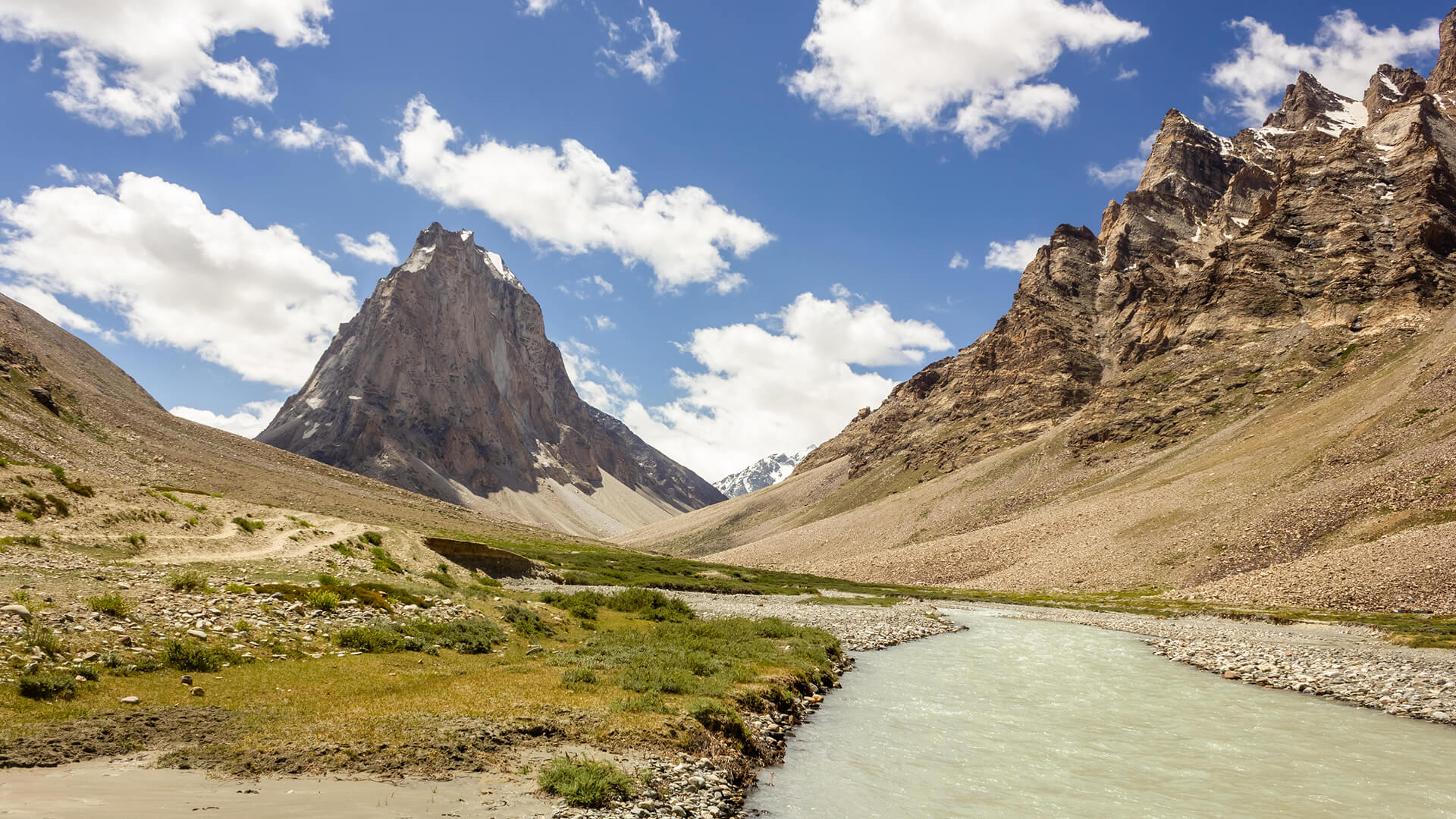
Padum to Darcha Trek: Complete High-Altitude Route Guide
The Padum to Darcha trek covers ~115–120 km in 8–9 days, crossing Shingo La (~5,060 m) between Zanskar and Lahaul.
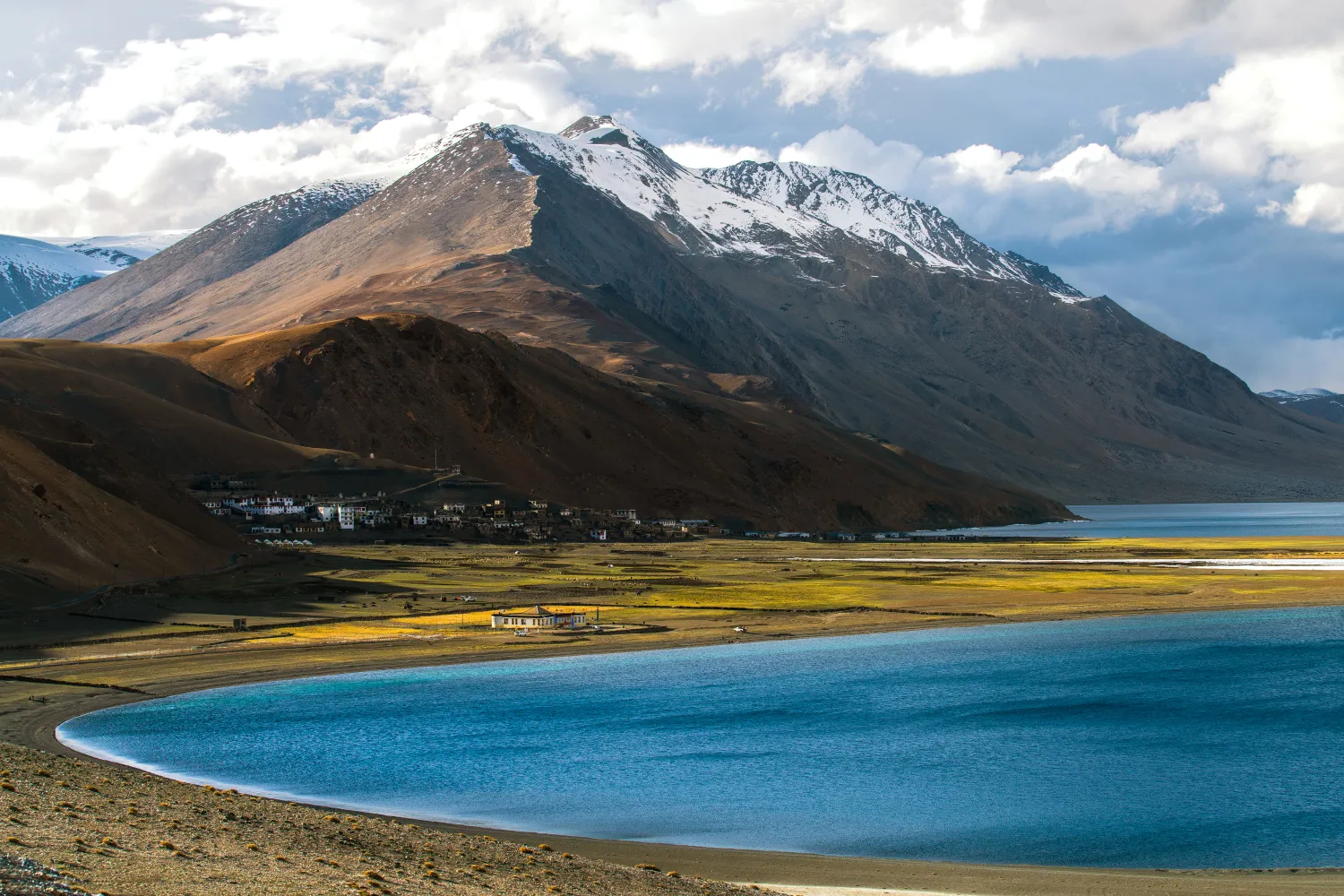
Rumtse to Tso Moriri Trek: Complete Ladakh Trail Guide
The Rumtse to Tso Moriri trek is an ~80 km, 7–8 day strenuous Ladakh trail crossing Kyamar La (~5,460 m) and Polokongka La (~5,190 m), ending at Tso Moriri Lake
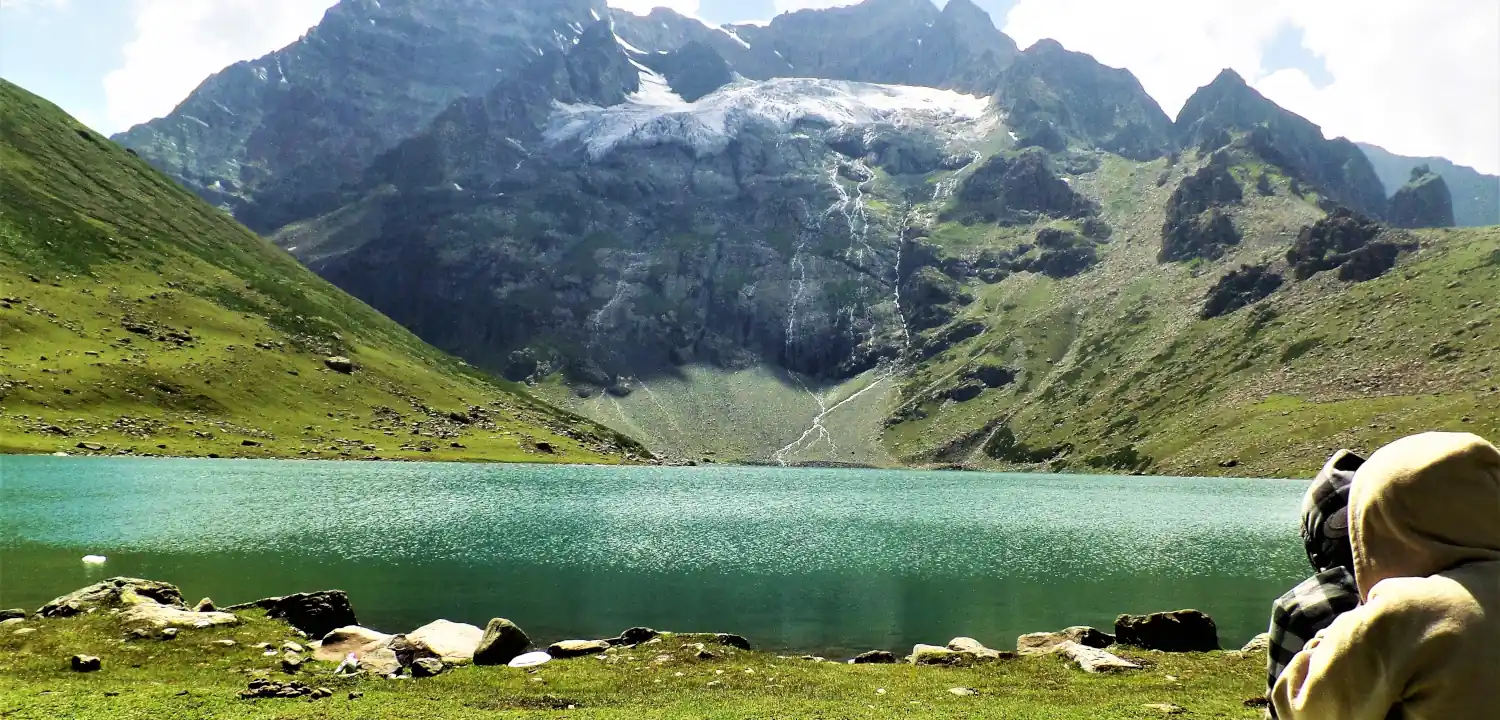
Naranag Gangabal Trek: Complete Guide (2026)
The Naranag Gangabal Trek is a 4–5 day moderate-difficult alpine trek in Kashmir, covering ~26–30 km from Naranag (2,150 m) to Gangabal Lake (3,570 m).
Common questions answered
The Markha Valley trek is rated moderate-to-challenging. The highest point is Kongmaru La at 5200m, daily distances reach up to 18 km, multiple river crossings add a technical element, and the rocky terrain demands sure footing. Trekkers should have prior high-altitude experience (above 4000m) and at least 8 weeks of cardio and loaded-hike preparation. It is not suitable for complete beginners with no altitude experience.
Markha Valley Trek — Latest News
Live Conditions
Real-time weather & trail status
Trail Conditions
Crowdsourced reports from trekkers who've done this route
Sign in to add a trip report
Find a Trek Buddy
Connect with trekkers planning the same route
No buddies yet for this trek
Sign in and be the first to post a planning signal.